
End of an Error
Platform Collapse and the Limits of Attention in Crypto

The end of Nifty Gateway didn’t arrive with much drama. There was no reckoning, no apology, not even a moment of reflection. It arrived as a date on a calendar and a set of instructions: withdraw your assets, move your art and do it before the window closes. That alone tells you how the platform understood its relationship to culture.
I remember Nifty Gateway as one of the first NFT platforms I ever encountered, alongside Rarible, where I made my first digital art purchase. It was February, 2021 and after being hyped up in Clubhouse, I purchased a first edition of Micah Johnson’s genesis project: Aku, The Moon God. At the time, these platforms felt like portals, early infrastructure for a new way of thinking about ownership, distribution, sovereignty and creative life in web3. What mattered then was the possibility of it all, what matters now is the clarity that it lacks.
Nifty Gateway never positioned itself as a cultural commons, but more as a premium storefront: credit cards instead of wallets, custody instead of keys, curation instead of community. That orientation shaped everything that followed, which artists were centered, which collectors were courted, and which forms of culture were allowed to accumulate there. Despite Micah and a few others, Black art was never meaningfully part of that vision, neither structurally, narratively, nor economically. NG aligned itself with whales and with a narrow tier of “top” creators, reinforcing a familiar hierarchy dressed up in new language. It mirrored the traditional art market more than it challenged it, even as it benefited from the rhetoric of disruption. So, when the platform announced it was closing, I didn’t feel sadness but confirmation.
::Shrug::
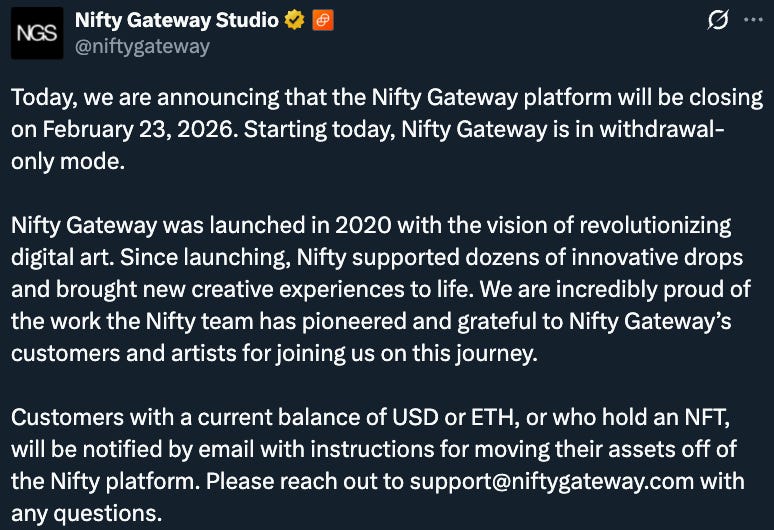
What has been more revealing than the closure itself has been the aftermath, the moment the abstraction broke. On X, collectors and artists began sharing their experiences trying to withdraw work from the platform — screenshots of error messages, stories of dead ends, practical hurdles replacing any talk of theory or ideology. One collector joked that Nifty Gateway was effectively telling them to go f**k themselves because they couldn’t withdraw an NFT over a fifty-three cent balance. Fifty-three cents became the line between access and loss! That detail matters because it exposes the reality beneath years of polished UX. Ownership that depends on a functioning interface, a maintained platform, and a cooperative intermediary is permission granted conditionally and revocable without ceremony. The urgency wasn’t about speculation but about the realization that what people believed they held securely could become unreachable through nothing more than corporate wind-down procedures.
Collectors are inconvenienced by moments like this, but artists are endangered by them. For artists who built on Nifty Gateway, the shutdown raises immediate, material questions: Where does their work live now? How do collectors find it? What happens to the context that once framed it? Platforms exit cleanly while artists inherit the consequences. This pattern didn’t begin here but is simply being made visible.
Ownership that depends on a functioning interface, a maintained platform, and a cooperative intermediary is permission granted conditionally and revocable without ceremony.
Long before Nifty Gateway announced its closure, people had already begun stepping away from Web3, quietly, after recognizing that the systems being built no longer reflected the values that drew them in. Leaving was a decision not to continue lending credibility to infrastructures that treated culture as fuel rather than responsibility. Leaving Web3 does not mean leaving the work; the art remains, the writing remains and the relationships remain, too. What collapses is the illusion that platforms are neutral stewards of culture rather than conditional hosts.
This is where custody stops being a technical detail and becomes a cultural question. Who holds the keys determines who controls access, memory, and continuity. When platforms hold custody, they mediate legacy itself, deciding whether work remains visible, transferable, legible. When they exit, that mediation fractures. Nifty Gateway’s closure makes this plain as day.. The art does not vanish from the blockchain. Contracts persist, metadata survives, but what disappears is the pathway: the interface that once contextualized the work, the discovery mechanisms, the social layer that made the art intelligible to anyone beyond a small circle of insiders. That loss feels uneven. Artists with institutional backing or strong collector networks can re-anchor their work elsewhere while others drift into obscurity because the infrastructure that once held it together has evaporated. Culture does not vanish when platforms die, but it thins out considerably. So when context erodes, memory becomes harder to access and what remains is work that is difficult to locate, interpret, or pass on.
But while crypto Twitter continues to spiral over Nifty Gateway, a man was killed in Minneapolis. That fact landed in the same news cycle and the contrast is impossible to ignore. The volume of analysis, outrage, and hand-wringing over a marketplace closing sits uneasily beside the silence that greets actual violence, loss, and consequences unfolding in the world most people live in. This disconnect has become a defining feature of crypto culture, especially among the men who still style themselves as its ideological core.
There is a kind of Stockholm syndrome at work now, a loyalty that no longer needs justification. Donald Trump did not usher in the bull market they promised was inevitable. He sure as shit did not stabilize crypto and he did not rescue NFTs. Bags are down, NFTs are scraping toward zero, liquidity is drying up, platforms are closing, and still there is no reckoning. What he has done is far more banal and far more damning: made millions for himself off meme coins and shady projects while the broader ecosystem bleeds out.
When context erodes, memory becomes harder to access and what remains is work that is difficult to locate, interpret, or pass on.
Value was extracted at the top while everyone else held the bag. The pattern is old enough to be boring, and yet it is met with reverent denial. That silence is telling, psychologically more than politically. Admitting the future didn’t arrive would require admitting they were wrong, that they were used. So attention shifts toward platform closures, toward Nifty Gateway, toward symptoms that can be critiqued safely without touching the rot underneath. This is where obsession with infrastructure becomes a coping mechanism. It’s much easier to mourn a marketplace than to confront the collapse of belief itself.
The end of Nifty Gateway is an ending that clarifies what was never built to last. The error was believing that platforms optimized for growth would also protect the work when growth stopped. Platforms will continue to close. The question is whether the work will always be forced to move in their wake or whether we are finally ready to build infrastructure that treats culture as something worth carrying forward even when belief collapses. That is the work that remains.
Well put. They were never really in it for the culture or the technology